Data Recovery, recovering Hard Drive data, RAID data recovery

Looking for a Hero?

Memofix Data Recovery Services, a division of Memofix Hitech Services Inc. is looking for a talented data recovery specialist to fill a permanent position at our data recovery lab in Concord, Ontario. If you have a passion for problem solving, an unquenchable lust for knowledge and really enjoy helping people and businesses recover their irreplaceable data, we may have a home for you.

As a data recovery technician, you will join our team of proven data recovery professionals in our quest to become the most technically capable data recovery service company in the world. To become the greatest, we are looking for experts in many areas. We need skilled hard drive surgeons experienced in resuscitating damaged and crashed hard drives. We need PC3000 masters with in-depth knowledge of hard drive system areas (secret OS of the hard drive). And we need file system specialists with an intricate understanding of the various operating systems as well as a thorough understanding of RAID variations and rebuilding techniques.

If you have post secondary education in computers and 2 or more years of experience in the areas listed below, we want to talk to you;

  • Diagnosing and identifying hard drive problems.
  • Diagnosing and repairing of defective hard drive PCBs including NVRAM transfers.
  • Identifying defective heads and replacement techniques in a cleanroom environment.
  • Dealing with seized spindle motors.
  • Transplanting of disks into a new body and motor.
  • Using the PC3000, Data Extractor and other specialized hard drive tools.
  • Specialized techniques such as individual head imaging.
  • Performing hard drive hot swaps with a system area compatible donor drive and PCB.
  • Identifying, repairing and rebuilding file system structure damage in FAT, NTFS, MAC and Linux type operating systems.
  • Identifying striping schemes and pertinent parameters in various flavors of RAID.
  • Repairing and Rebuilding RAID arrays physically and virtually using various software tools.

Memofix offers competitive salaries, equal opportunities, a full benefits package, and a wonderful work environment for all of our employees.

If you have the skills, aptitude, and desire to join a team dedicated to becoming the best at recovering the world’s data, please send your resume to me at [email protected]. Please reference “Hero Ad” in your email subject line.


Deleted SSD Files … Gone Forever?

It wasn’t long after the introduction of the PC that computer enthusiasts figured out that if you deleted a file on your hard drive, it could generally still be recovered. This was possible because deleting a file only deleted its index entry while the file itself remained intact and undamaged. Armed with this knowledge, many IT professionals rescued deleted files and won the accolades of their panicked customers in the process. But the rules have changed with the modern SSD or Solid State Drive and in most cases, if a file is deleted from an SSD, the file is deleted forever!

data recovery Ontario
To understand why, it helps to understand a little more about SSDs.

Unlike a hard drive which can simply write over existing data, an SSD must 1st erase existing data before it can write new data. The process of erasing a data block is very slow in comparison to writing or reading a data block, and as a result 1st generation SSDs became considerably slower over time. To address this concern, newer SSDs started preemptively erasing recently freed blocks during their idle time. This process is referred to as garbage collection and is found in all current SSDs.

However, initially SSDs did not understand or communicate with operating systems like Windows, consequently when Windows deleted a file and marked the space as free for re-use, the SSD knew nothing about it. As far as the SSD was concerned, this space was written to and was thus in-use. To overcome this build-up of unknown and thus unavailable space, SSD manufacturers introduced a feature called TRIM. TRIM allows the operating system to communicate and inform the SSD of free data blocks as they become available. The SSD will then add these blocks to its list of blocks to be preemptively erased. Unfortunately in the real world, these blocks are erased and prepared for re-use almost immediately. Consequently, a deleted file is now totally unrecoverable within moments of being deleted.

Even if you do a quick format on an SSD, the data will be gone almost instantaneously and forever! Previously with hard drives, it was still possible to recover the original data files even if you formatted your hard drive. See our Recovering Data After a Format blog post for more information on that topic.

There are exceptions where deleted SSD data can still be recovered. This is usually because the SSD, operating system or storage configuration does not support TRIM. Below are some examples where TRIM is not supported and hence, deleted files may still be recoverable:

  • Using an older 1st generation SSD or Solid State Drive
  • Running Windows versions before Vista and MAC OSX versions prior to 10.6.8
  • Using an SSDs inside an external USB or Firewire enclosures, and most NAS boxes.
  • File system has become corrupted and the volume is no longer recognized or accessible.
  • SSD formatted with FAT16 or FAT32
  • PCI Express SSDs generally do not support TRIM
  • Encrypted volumes do not usually support TRIM
  • SSD RAID arrays do not typically support TRIM.

Solid Sate Drives are becoming much more common as the prices comes down and their benefits become apparent, but as always, there are tradeoffs, and understanding the implications is always important. If we can help resolve your data loss situation or if you just want a second opinion, please don’t hesitate to contact us at 1-800-MEMOFIX or [email protected].


Need a Data Recovery Expert?

Please allow me to introduce you to MemofixMan, the creation of our own Rob Armstrong. Not only is Rob a talented artist, he also has an incredible flare for recovering data. Rob can be found most days recovering data in the Memofix data recovery lab. We hope you enjoy his drawings and we hope to publish more of his creations soon.

toronto data recovery experts

External Hard Drives … SUV or Porsche?

Claremont, Ontario, Canada. At least every week we receive a few recoveries where the drive will not spin up. The problem is a physical issue where the spindle motor that spins the hard drive’s platters is seized. The cost of recovering from such a situation is quite expensive, but it may be possible to avoid such a dilemma.

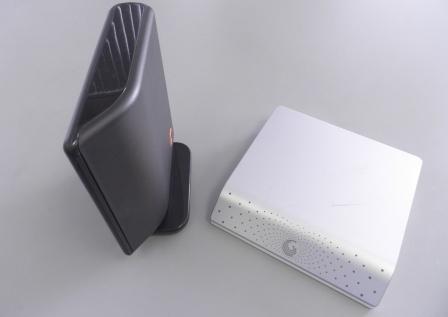
Manufactures design external enclosures that mount the drive either vertically or horizontally as shown in the picture below. Due to the high centre of gravity with the vertical units, they are extremely susceptible to being knocked over, which in turn may cause your hard drive’s spindle to seize. Avoid buying one of these vertically mounted external hard drive enclosure if at all possible.

External Cases

Vertically mounted (SUV) Horizontally mounted (Porsche)

While it’s true hard drives are designed to be mounted either vertically or horizontally, they are not designed to withstand much shock while operating. Approximately 10 years ago when hard drives were still designed with standard ball bearings in their spindle motors, they rarely seized. But in the quest for better performance, drives began using fluid dynamic bearings. With FD bearings, the metal balls were replaced with a layer of liquid. While there is no doubt that these bearings were superior in performance, they do have the disadvantage that under shock situations the fluid dynamic bearings can catastrophically seize. And that is what we are seeing so much of today. http://www.memofixdatarecovery.com/data-recovery-hard-drive.php … David Foster

FREE Data Recovery

Markham, Ontario, Canada. This is a story I love to tell. It reveals much of the human psyche and I find it fascinating

Back in the 90’s when Data Recovery type services were first starting to mature I was working for one of the pioneers of the industry, Nick Majors. Nick was a man of unquestionable integrity and honesty. So it was no surprise that nothing perturbed him more at the time than the massive influx of companies that suddenly “claimed” to be experts in data recovery. From cases that were sent to us for a 2nd opinion and through our own secret shopper program, where we sent data recovery cases to these so called experts, it became obvious that there were a lot of unscrupulous and opportunistic villains infecting the data recovery business. They made their money by getting in as many jobs as they could, charging an evaluation fee for each one, and then recovering the 10-15% of the cases that were the easiest (skimming the cream off the top as we referred to it back then) . They would do the cases where no parts and little intelligence were required … basically the cases that could easily be handled by any commercially available recovery software. Those they couldn’t recover were declared unrecoverable and the client was told they were out of luck.

So it was decided that we had a responsibility to save the world’s data from all these crooks and make some money off it at the same time. With huge fanfare and press releases, we announced our FREE-FIX program. Basically, we would recover people’s data for free IF it was a simple problem that we could resolve in 15 minutes or less. This would include logical problems with the file system, deleted files, formatted drives and pcb problems for common drives we had in stock. The program was intended for consumer users and was available on single hard drives with Windows or MAC data only. If we were successful, the client only paid for the return shipping and the media to put the data on. If the case was not eligible for FREE-FIX, we would provide the client with a no obligation quote for further recovery attempts.

We thought if we took the high road and did the easy stuff for free, we would kill this growing segment of con artists as they would not be able to survive without the easy jobs. And of course we also hoped that many of the ineligible cases would be approved for escalation into more desirable expensive jobs. We really felt that we would gain such a good reputation from this program that it would pay us back a thousand times.

Boy, were we wrong !!!! Yes most of the owners of the cases that qualified for FREE-FIX loved us. But the other 85% of the people were absolutely outraged at us. We were suddenly bombarded with irate clients wanting to rip a strip off of us. Those that we tried to “up-sell” because theirs’ was not a simple/free recovery, largely declined as they felt we were using bait and switch tactics. Even some of the 100 or so people who qualified for FREE-FIX every month thought we must be making money off the return media and the shipping. Shortly after the 1st month, the FREE-FIX experiment was cancelled and quickly disappeared into the growing mist of the World Wide Web, never to be heard of again. … David Foster