


Posts Tagged ‘disk recovery’

Data Recovery for Dr. Dell in Haiti

Wednesday, January 11th, 2012

Data Recovery is often a thankless business. We can spend hundreds of dollars on parts and many late days attempting to recover someone’s critical data files. And in the end, if we are unsuccessful, we don’t get paid and rarely do we get a thanks for our efforts, no matter how hero like our recovery efforts may have been. So when we receive a great big thank you and some pictures showing the fruits of our labour in use, we really like to soak it up. :-)

“Hi Bob,

you probably remember me from a few months ago. I had the hard drive from an X-ray machine in Haiti that had failed due to a power surge. I though you may be interested to know that thanks to the drive your company recovered the machine is now working again. I’ve attached some pictures for you from the mission in Haiti including pictures of the C-arm being used during a knee operation. The surgeon in the picture is Dr. Dell who covered the cost of the recovery. This surgery to implant a plate in a patient’s damaged knee would not have been possible without a working x-ray. I thought your team would appreciate seeing the results of a job well done.

Thanks and Blessings, Geoff “
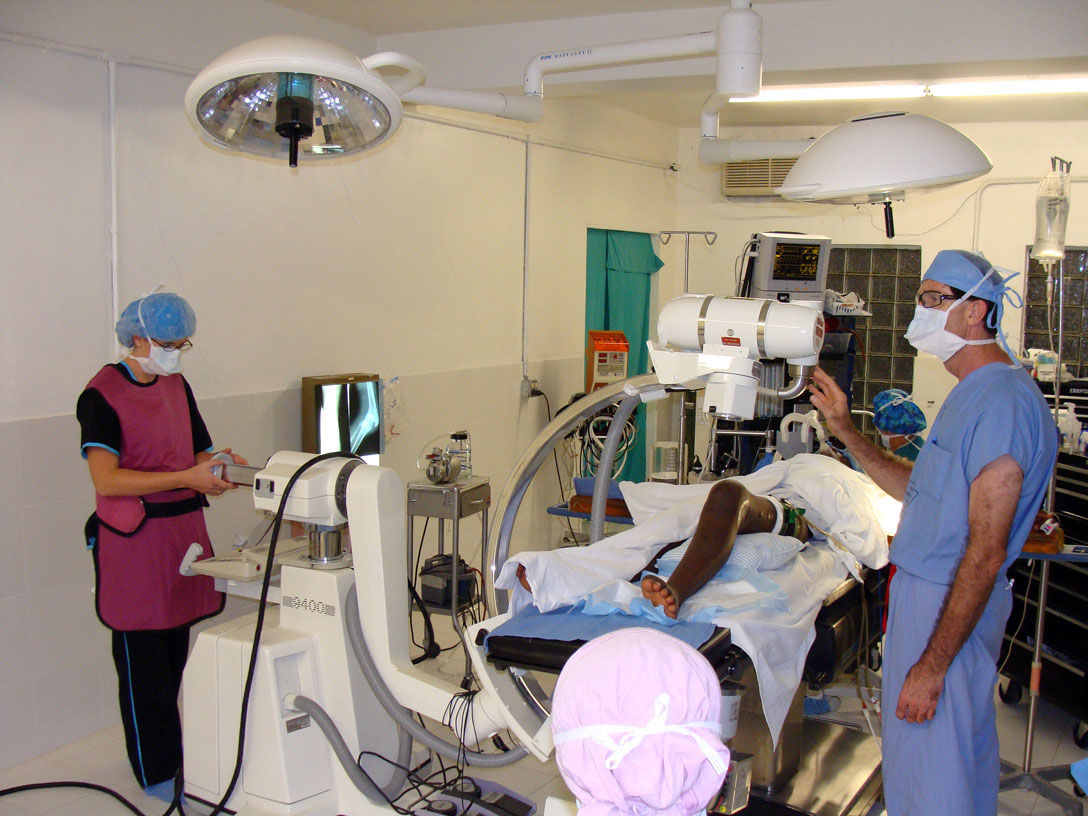
The Real Doctor of Recovery, Dr. Dell doing his thing in Haiti

Back in August, Geoff, an associate of Dr. Dells asked if we could recover data from an old Quantum hard drive being used in an older X-ray machine in Haiti. It was a 52 MB hard drive, yes 52MB or .052GB or .0000052TB, small by today’s standards that’s for sure. As the disk drive was very old and few data recovery companies other then Toronto’s Memofix Data Recovery Services had the experience or parts to deal with it, we were asked to attempt the hard drive recovery in Toronto.

As it turns out the hard drive had been damaged by a power surge and it’s printed circuit board or PCB was fried. Additionally and more detrimental to our data recovery efforts, the surge damaged a small pre-amp chip that is located on the head assembly inside the sealed disk drive compartment. The chip is used to amplify the signals from the individual heads to the PCB and without its proper operation, no recovery would be possible.

On a current modern hard drive, we would simply replace the entire head assembly but this older Quantum hard drive used a unique hybrid positioning system for controlling the heads and it could not be simply replaced with a new one if the data was to be recovered. This hybrid positioning system used a combination of an optical encoder for rough head positioning and an embedded servo system for fine positioning. As a result the relationship between the two positioning methods was critical and could not be altered or replaced with anything but the original mechanical parts.

With Memofix’s grey haired experience in repairing legacy hard disk drives we were able to replace the pre-amp chip on the original head assembly and restore the hard drive to an operating state. We then created an exact image of the entire original hard drive onto a new Quantum 52AT hard drive. Interestingly enough, we had a new Quantum hard drive sitting in our stock, still sealed in a bag we received directly from the now defunct manufacture in the early 90′s.

Sometimes it’s good to be a pack rat that’s been around forever! Especially when our efforts in Toronto help a good doctor spread heath and healing through a country that really needs everyone’s help. May the forces of good be with the people of Haiti!


Data Recovery Second Chances

Thursday, December 1st, 2011

Here is a story that our head of client services in Toronto wishes me to tell. It’s a story that happens just a little bit too often …

A few weeks back we had a gentleman drop by with a Western Digital hard disk drive for possible data recovery services. The client was quite anxious so we did a while-u-wait evaluation and quickly discovered the disc drive couldn’t spin up because it had a defective PCB or printed circuit board. After reading off the original NVRAM memory contents* and transferring them onto a compatible PCB we soon had the drive spinning again. However we still couldn’t access the client’s data and further analysis revealed there was a second more complicated problem with the drive’s SA or “system area” modules, (kind of a secret operating system stored on the drive’s disks or platters and for its own exclusive use). After some attempts to repair the damaged SA modules it became apparent that it would take further research and time to solve the corruption. We did however believe we had enough information to quote the customer and we proceeded to do just that.

With multiple hard drive problems we don’t typically charge twice as much but we do add a premium and this recovery was quoted at $800. And as often happens, the client was aghast at the figure and decided to decline our data recovery quote. Fair enough, we realize the real value of the data can only be determined by the owner so we packed up the case and handed it back to the gentleman. See this older blog post “Data Recovery Pricing and Why were not the Cheapest” to better understand the data recovery pricing process.

A week or so goes by and we get another visit from the same gentleman. This time he is ready to agree to our quote and he leaves the drive with us. However, once we get the disk drive back into the lab, we see stickers on it from one of our competitors, the largest data recovery company in the world ! And worse yet, the drive’s bubble or sealed environment where the disks are located had been opened.

Oh oh, why would they open the drive? Our initial evaluation revealed no problems with the actual disc media or the read/write heads, so we better take a look. Under class100 clean room conditions we open the hard drive and find a crash forming on the top surface minimally. The crash has formed a ring and can only be created by continuing to operate a crashing hard drive. We then remove the head assembly and inspect each head for damage and contamination. This process reveals additional crashes have developed on the lower disk surfaces. The damage is so severe; the odds are against us recovering anything of value!

We contact the client who admits he did bring it to a competitor BUT he swears it was only for another evaluation and quote. He was trying to find a better price. After “evaluating” his hard drive recovery for 2 days, the other data recovery company told him it was unrecoverable!

This is where the illusion of two totally different outcomes must be addressed and the difference in data recovery processes exposed! Here’s what happened …

The world’s largest data recovery company receives a hard drive for data recovery. The drive is received and they immediately attempt to recover all the data possible. If they can’t recover any data they declare it unrecoverable. If they can recover some data they send the client a list of what they can recover and a firm quote. The recovery is already attempted, the results are already in. There is no proper “do no harm” evaluation or diagnosis. There is little chance of anyone doing any better once they are finished with it. Any 2nd chances are effectively destroyed!

What makes matters worse is what happened with this case. What would have been a 99% chance of a successful recovery with Memofix Data Recovery Services turns into a 100% unrecoverable situation. Whether the new damage was caused by mishandling during its transportation or whether it occurred during our competitors “evaluation” cannot be said, BUT I can tell you the result is the same. Somebody is not going to see their data ever again.

IF a data recovery company can’t give you an evaluation without doing further harm to your hard drive then they don’t know what they are doing, period! Memofix stands by every evaluation we perform and furthermore our processes do NO harm. Consequently if you get a 2nd opinion after a Memofix diagnosis it should confirm exactly what we discovered. Of course actual data recovery pricing for the same diagnosis may differ between competitors, especially in Toronto.

IF a data recovery company uses a process where they attempt to recover the data immediately from any data recovery case they receive, don’t use them. Even if they successfully recover your data, their attempts may have denied anyone else a chance of recovering your data AND consequently they can hold you over a barrel as they have the last obtainable copy of your data in the world.

Remember, the 1st attempt at recovering data from a hard disk drive is typically the most successful. The longer a failing hard drive is operated, the worse your chances of seeing your data again. Choose a data recover provider with the same care that you would use to choose a surgeon, your data may depend on it.

*PCB swapping on most HDDs is not a straight exchange (even with an exact firmware PCB), as the PCB stores settings specifically tuned for its original set of disks and heads. .


Toronto and Vaughan RAID Data Recovery

Wednesday, November 16th, 2011

Enterprise level RAID arrays often use SCSI or SAS (serial attached SCSI) hard disk drives. Compared to PATA and SATA IDE hard drives, SCSI and SAS are not as common. And as a result few data recovery companies have much experience with them.

Fortunately, Memofix (located in Vaughan, Ontario) has been around for so long that we still remember when all servers and RAID arrays used SCSI hard drives. I too have been “around” for a long time and during my 12 years at ActionFront and Seagate Recovery Services I was the “go to guy” for SCSI recoveries. By the end of my career at these Toronto GTA based recovery companies, I was full-time management with the exception of working exclusively on cases that used SCSI hard drives. As a result, I became thee expert at resurrecting dead SCSI and SAS drives. And as they were most often used in RAID arrays, my skills at rebuilding and recovering RAID data was also very good.

At Memofix this expertise has been passed on, but I still personally monitor every SCSI, SAS and RAID array we receive. I believe we are the best in the industry whether that RAID is used on a MAC. Windows, Unix or even a Solaris operating system. If you need some expertise on your failing RAID call the professionals. http://www.memofixdatarecovery.com/data-recovery-raid.php