
SD cards and microSD cards are flash-based storage devices used extensively in cameras and phones. You can see the size difference between a microSD card and a full size SD card in the two pictures below.


Both SD and microSD cards are functionally the same as USB flash drives. Both share similar components including a memory chip(s) and a controller chip to manage the memory device(s). Below is an example of a typical SD card showing both sides of the device with the plastic casing removed. On the left hand side picture you can see two larger memory chips and a smaller black controller chip.


SD cards can be manufactured as a device comprised of the individual components (memory and controller) like the example above OR they can be manufactured as a monolithic device like the picture below. ALL microSD cards are monolithic devices.
A monolithic device has the controller, memory chips and any other discrete components, combined and built into a single chip or device. It is one piece so you cannot break a monolithic device down into discrete components. To the eye, a monolithic device appears as just a piece of black plastic like the examples below.


When monolithic or non-monolithic devices become dead, inaccessible or unrecognized, they require different methods to recover the data.
With non-monolithic devices we can remove the individual memory chips and read the raw data using a standalone chip reader. However, the raw data is “very raw” and still requires extensive analysis to determine the layout of the data and customized software to put the pieces back together into a useable format. Even a flash device with one memory chip requires this rebuilding of the raw data. Some of this complexity is a result of a technique used by flash called “wear leveling” where the device tries to use all the memory cells equally so that no particular memory cell becomes worn out sooner than its neighbours. As a result, many of the storage cells will appear to have copies of the same data, but a closer inspection reveals the contents are older versions of the data waiting to be re-used with new data. Consequently, we must use the raw contents of the device to determine how it all fits together. It is somewhat like a giant jigsaw puzzle.
With a monolithic device, we cannot remove the memory chip(s) as they are all part of the same package. In these situations, we need to remove the plastic coating from the device so that we can visually see and map out the circuitry (see the photo to the right).
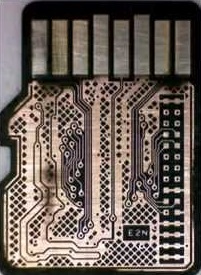
Then we need to determine how we can connect to this existing circuitry in order to gain access to the memory contents. Some connections for previously discovered microSD cards are shared and available to professional data recovery companies using a web-based database.
However, if the database does not contain details on the “to be recovered” device, the entire mapping out process can be quite tedious and can take anywhere from a 5 days to 5 weeks. Once the circuitry layout has been determined, we can use that information for future data recoveries from the exact same device. The bad news is that very few SD or microSD cards will share the exact same layout.

Having determined where we need to connect to the device, we now must tediously solder wires from the adapter board to the device. Then we are able to use a chip reader to connect to the adapter and read off the memory contents. Finally, we need to figure out the data layout as we do with the non-monolithic devices and ultimately recover the data. To the left is a picture showing our connections to access the memory devices on a monolithic SD card.
Our typical fees for recovering data from unrecognized SD cards that are non-monolithic range from $500-$1200.
Unfortunately due to the massive amount of work required, our fees for recovering data from an unrecognized monolithic SD card or microSD card are even higher. Expect fees in the range of $1200-$3000. depending on whether we have existing layout information for your particular device.
As always, our evaluations are free and our work is guaranteed to make you happy or you don’t have to pay a nickel. To send us a new case now, please click here.
 October 24th, 2012