Posts Tagged ‘seagate data recovery’

MELTED DATA

Friday, May 8th, 2015

Almost every month someone in Canada sends a hard drive that has been involved in a house fire. They often resemble burnt bricks like the picture below of a drive we recently received from a client in London, Ontario. None of our techs were in a hurry to get their hands dirty, but as terrible as these situations look, there is often an easy recovery lurking just under the mess!

Plastic melts easily and this external hard drive is in-cased in plastic like a pair of jeans on a teenager in the 80’s.


But with a little invasive surgery we are able to free the hard drive from its prison.

But will the prisoner be able to talk?

As we have discussed various times in this blog, it is the condition of the disks that will ultimately decide if we can make this hard drive talk again. So let’s open the bonnet and have a peak under the hood …


WOW! It looks pristine. Notice the lack of any contamination due to the fire or the liquids used to douse it. We proceeded to perform a full recovery on this case by replacing only the PCB


Below is another fire victim from a client in Montreal, Quebec which was not in such great shape when we opened the lid. In fact, it may not be recoverable … but we’ll never know for sure as the client declined our quote.

As a general rule for data recovery purposes, fire damaged drives are not typically unrecoverable due to the heat and smoke of the fire, BUT more often, it is the excessive use of firefighting liquids that do the damage, especially if they are allowed to dry out. The drying out leaves mineral and other debris deposits on the disks which are tough to overcome.


And here is a look of what happens when someone applies power to a fire damaged hard drive that has had the sealed assembly breached. You can see the deep ring on the inside of the disk where the heads are. This disk drive will NOT be recoverable.


So if you have a sad looking case of melted data don’t give up hope, data recovery may be as easy as a PCB replacement.


The Challenge of Being Unique

Tuesday, November 27th, 2012

Today’s blog features a guest post from Andrew Gotshal, one of the original founders of Memofix. – David Foster

Occasionally, when meeting with manufacturer partners or corporate executives, I’m asked what makes Memofix different in the marketplace. What sets us apart from other technical services organizations? What unique advantage or value do we provide to customers?

It’s easy for us to list all the important stuff that OEMs and customers want to hear. With over 25 years of experience we have a proven track record. The majority of our business comes from returning clients and word of mouth referrals, demonstrating our commitment to customer satisfaction and quality. We regularly pass performance tests and service level agreement metrics with our manufacturers; which means we deliver on our depot warranty commitments. Our technical expertise allows us to tackle tough problems and provide complete solutions. But most competitors who are focused on customer responsiveness and quality can provide those same attributes. So why are we different?

Server data recovery

Our company is a family of individuals from different backgrounds and unified by one important characteristic – we’re Geeks. Capital “G” Geeks who want to understand the technology that we are working on, to figure out why a problem is occurring, how do we fix it and can we make recommendations to ensure it doesn’t happen again. Customers who throw us unique challenges tell us that they like our thought process. Instead of jumping to a conclusion we start running through the various scenarios that could result in the reported problem. Then we start our testing process to eliminate one or the other and focus on the root cause. Think of us as the child who takes apart the family computer so we can figure out how it works. Except when we put it back together again, we’ve made a few improvements and it runs a lot better.

Memofix loves storage technology, it runs in our blood. That’s not to say we are singularly focused – we are after all one of the largest national providers of depot services for a leading notebook OEM. But in the same way that you have a fondness for that first person you dated seriously, we look back on our start as the repair centre for the first Seagate drives that entered the Canadian market. This has led to our investment in specialized equipment to analyze and recertify hard drives. Because we have some of the brightest technicians in Canada we are one of a select group in North America that can repair hard disks and complex tape backup technology. Our membership in the Technical Services Consortium (www.tsc-ww.com) gives us global access to service expertise, parts and process improvement. After almost 30 years in this industry we continue to look for ways to improve our capabilities and provide more value to our business partners and customers.

We have tackled some unique challenges for our customers and the ones that we are proudest of generally were not the most profitable but they appealed to our Geek side. Here are some examples:

  • A clinic in Haiti relied on their 20 year old X-Ray machine to provide badly needed medical care. When the hard disk started to malfunction they searched extensively for a solution because replacement was not an option. We were able to supply the parts needed from our spares (largest spare parts inventory in Canada), recover the data and earn a big thank-you from the medical staff.
  • Customers regularly come to us with specialized production equipment that is decades old, with a similarly aged hard disk as an important component. In almost every case we have the parts and the technical expertise to keep this equipment running, including a 3.2MB hard disk that we provided to a data recovery customer just last week.
  • Where a replacement drive is not available for an older system, we have been successful in using newer drives and reducing the capacity so that it will be accepted by the legacy operating system or application (known as destroking). In some cases our technicians will also need to reconfigure the firmware on the drive, an important skill for us and rarely found outside OEM organizations.
  • During the recent hard disk shortage, caused by flooding in the Philippines, several OEMs approached us to leverage our expertise in firmware re-configuration, in an effort to use alternative drives for computers that had been designed for specific models and brands of hard drives.
  • We have been able to provide feedback to our OEM partners on their testing process, helping them to understand that perfectly good drives were failing due to their audit software. The result for our manufacturer partner was a higher yield and lower replacement costs.
  • Several retail chains rely on us to wipe personal data from storage devices returned by their customers. Wiping Xbox hard drives and flash drives presents a unique challenge because the operating system is embedded with the consumer data. Our technicians were able to create an algorithm which would detect where the OS is located on the HDD or flash drive. This meant wiping all data up to the OS, recognize where the OS is and leave it intact, and start removing consumer data immediately after.

Another important element of our uniqueness is attitude. We are never more important than the customer’s we serve. We customize programs to accommodate the customer’s process branding, financial models, and security. Manufacturers come to Memofix in order to reduce their costs and we approach each new project with that objective in mind, including pricing our services based on the OEM realizing those financial savings. We are willing to share the risk and create a partnership versus simply being a supplier.

The challenge of being unique comes from constant re-evaluation of what’s important for your partners and clients, and how we adapt to meet those changing needs. To be relevant to the marketplace you have to stay focused on the customer and not your competitors. You have to resist the urge to concentrate on revenue and expense reduction, and instead invest in skills, people, technology and process in order to be successful through long-term relationships. We try to meet that challenge every day and so far our customers are telling us that we’re doing OK.

Andrew Gotshal

Founder, Memofix


Hard Drive Substitutes or Data Killers?

Thursday, May 3rd, 2012

Since shortly after the inception of the hard drive into the PC or personal computer, there have been doubters! Even as hard drives grew larger, faster and more reliable, there have been those who constantly called for its replacement. No other product has improved at a faster pace in every measurable specification than the hard drive, and yet it still gets no respect! The hard drive is still here and still going strong after more than 50 years. Has the time come for a new champ?

data recovery toronto

Back in 1985, I repaired my first hard drive. It was a 5MB hard drive made by Seagate called the ST506. The ST506 had actually been introduced a few years earlier at a list price of $1400! It was the 1st hard drive mass produced for the emerging personal computer market and its interface quickly became the world’s standard … well at least for a few years. The ST506 hard drive had 156 tracks or concentric rings of data on each disk surface. In comparison todays modern hard drives have over 200,000 tracks, can hold up to 4TB or 4,000,000 MB and often cost less than a $100. For a visual comparison, I dug up an old ST506 out of our inventory and took a picture of it along with a modern 500GB laptop hard drive.

Today we have two contenders trying to put the old disk drive out to pasture: the SSD or Solid State Drive and Web Based Storage. Both are worthy contenders offering advantages a hard drive just can’t compete with. An SSD offers lightning fast access times and the reliability of no moving mechanical parts. Web based storage offers the convenience of having your data available around the world 24/7, 365 days a year and the perceived reliability of virtual storage. But are these storage methods the end and be all?

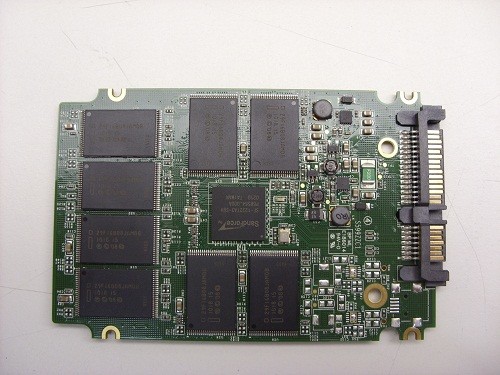
Contender#1 … SSDs or Solid State Drives with their blazing speed and growing capacities appear to be a fantastic replacement for the hard disk drive, but be aware they are far from being the perfect digital storage device.
SSD data recovery

These early days of Solid State Drives, reminds me a lot of the hard drive industry as it was first developing. In those early days there were over a hundred different manufactures of hard disk drives. Now there are just 3, Seagate, Toshiba, and Western Digital. Similarly, today we find well over a hundred companies manufacturing SSDs. And just like the hundreds of early hard drive manufactures, each one is trying to distinguish it’s technologies as the best and capture the most market share. Some of their ideas will be fantastic and will be quickly adopted as standards. Other not so good ideas, may result in the demise and eventual death of many of these companies.

A quick search on the web uncovers hundreds of complaints regarding the early failure of various models of Solid State Drives. The point is … there will be a weeding out process where the weaker products and companies are culled from the herd. And as a consequence it is still a little too soon to know which SSDs and technologies to trust, and which to avoid.

There is also an ongoing debate over the life expectancy of SSDs and whether they can withstand the same amount of lifetime write cycles as a typical hard drive. And while I don’t believe this is, or will remain a problem to be concerned about, there is another rarely mentioned quirk with SSDs. If you copy data to an SSD and detach it from any computer or power source, the data will eventually disappear! This is because SSDs use electronic components which are “charged” to represent a digital 1 and over time this charge leaks out and all the bits return to digital zeroes. So if you think you can copy your precious baby pictures to an SSD and put it away for 10 or 20 years, think again! Actually, just how long the data will be retained is open to argument and something no manufacture appears to mention. I have heard data retention times as low as 1 or 2 years and perhaps as high as 10 years from some authorities. So be careful, or be sure to periodically attach your SSD to a computer or power source so that the data will be refreshed. By the way, I have connected and booted up an old 20MB Seagate ST225 hard drive that has been sitting on a shelf for just under 20 years and all the data was intact and readable.

Contender#2 … Online or web based storage really does promise perfection, or at least so it appears on the surface. But what guarantees do you really have that your data will be there when you need it? Everything is out of your control. And if the web is down or inaccessible, then you basically have no data.data recovery Ontario

To illustrate my concerns, a recent experience of mine may help. Having used Google’s Gmail for almost 10 years with never a problem, I recently persuaded my wife to open her own Gmail account for her own personal emails. Then six months after the switch, her emails suddenly disappeared. Of course it was my fault for persuading her to switch over to Gmail, so I was tasked with getting her emails back … What I found was rather discerning; there is no real process, and definitely no person to help you recover your mailbox data should such a calamity bestow you. Google basically says “Oh well, what do you expect when something is free?” To which what can one say? Of course the solution is to use an email agent like Eudora and download your emails to your local machine. But then doesn’t that defeat the purpose of on-line storage?

Not to pick on Google, (they should be prepared to defend their “web only” cheerleading), but I have another example based on their product, Google Docs. It is touted as a web based replacement for MS Office. It allows a user to create, edit and store MS Office type documents on the web. But after my experience with Gmail, I must wonder what recourse there will be if suddenly all your documents go missing? I hope this problem of no accountability for the safety of a user’s data is isolated to those offering free storage services. But with Google setting the precedent of giving storage away for free I am afraid other web based program providers will do the same.